
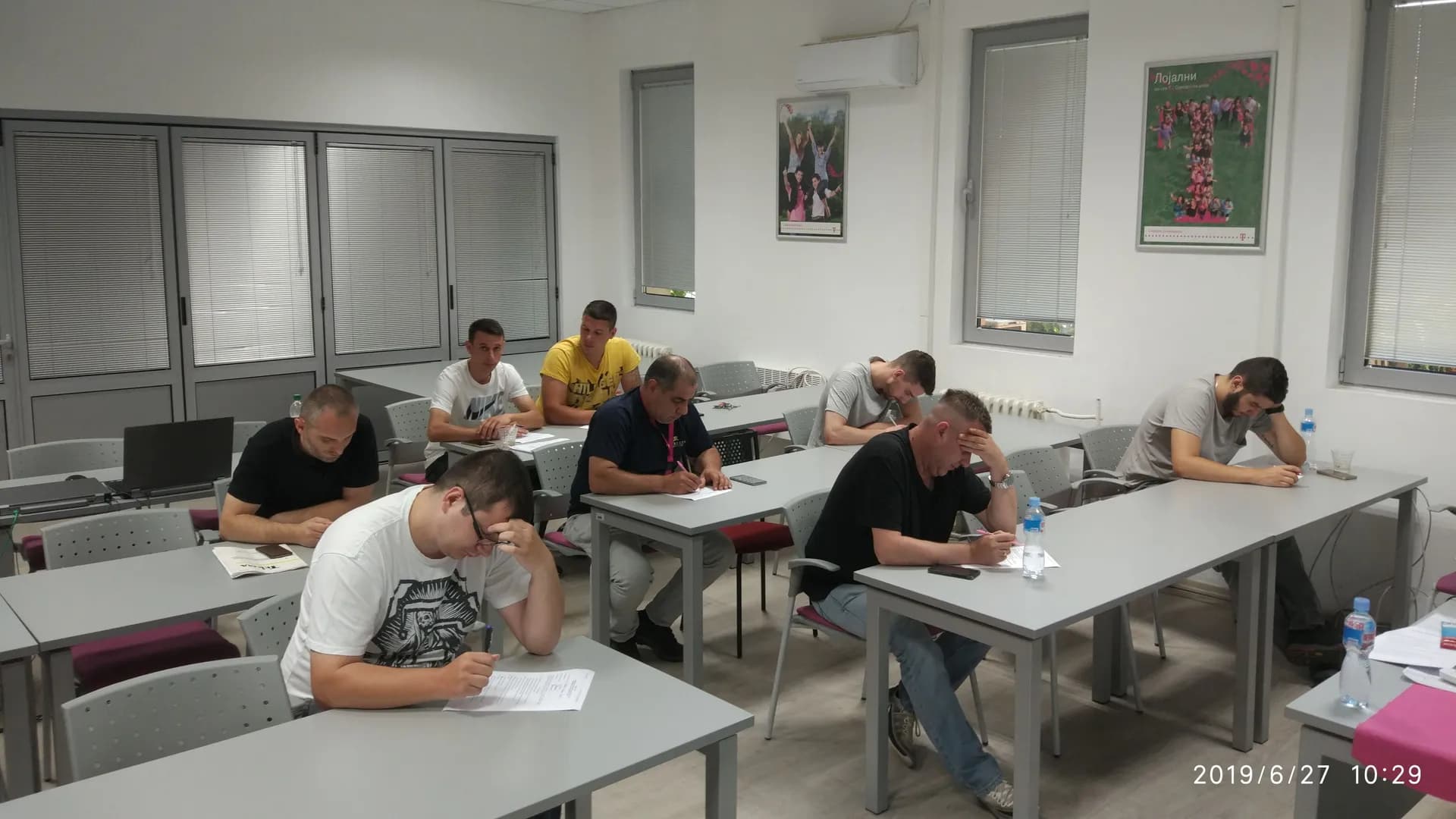
Occupational safety training is not a formality carried out once on hiring. The Occupational Safety and Health Act requires the employer to provide every employee with theoretical and practical training on four distinct occasions, and for workplaces with increased danger — a competence check every three years (original text Official Gazette of RM no. 92/07, as subsequently amended, most recently in Official Gazette of RNM no. 74/25). The absence of training is an offence in the highest category.
Who must complete training
The obligation has no exceptions by company size or activity — the Act applies across every activity in the public and private sector and to everyone involved in the work processes (Article 2(1)). Even an administrative worker in an office must have training, simply with content matched to their risks. The obligation also covers employees who are not on your payroll: an employer using another employer's workers under a contract must provide them with all instructions and information on the risks (Article 26(2)).
When training must be delivered
| Trigger | When | Basis |
|---|---|---|
| On hiring | Before independent performance of the work | Article 31(1) |
| On transfer to a new workplace | Before the new work begins | Article 31(1) |
| On introduction of new technology or new work equipment | Before it is put into service | Article 31(1) |
| On every change to the work process capable of altering the level of safety | Before the change is applied | Article 31(1) |
| Competence check for workplaces with increased danger | Every three years | Article 31(5) |
| Practical evacuation and rescue drill | At least once every two years | Article 24(4) |
| Repetition ordered by a labour inspector | Within the deadline in the decision | Article 31(7) and (8) |
Note what is not in the table: a general one- or two-year interval for all employees. The Act prescribes none. The three-year cycle applies to employees at workplaces where the risk assessment has established an increased danger of injury and harm to health, and to workplaces with an elevated number of workplace injuries (Article 31(4) and (5)). Which workplaces those are in your company is shown by the risk assessment, not by assumption.
Theoretical and practical training — both
Training must be adapted to the specifics of the workplace and delivered according to a programme, which must be kept up to date and amended in light of new forms and types of risk (Article 31(2)). Theoretical and practical training takes place during working hours, at the employer's premises or elsewhere (Article 31(3)).
For workplaces with increased danger the employer establishes mandatory regular theoretical and practical examinations on the safe performance of work (Article 31(4)). It is therefore not enough for the employee to sit through a lecture — the knowledge is tested.
The entire cost of organising and delivering training for employees and their representatives is borne by the employer (Article 31(6)). The Rulebook on the cost of performing specialist occupational safety activities (Official Gazette of RNM no. 275/19) prescribes minimum amounts: MKD 600 per person for training fewer than 25 employees, MKD 400 per person for training 25 or more employees, and MKD 400 per person for the three-yearly competence check.
Preparing and delivering training programmes is one of the specialist activities for which the Ministry of Economy and Labour issues a licence (Article 45(1)) — meaning the programme may not be drawn up by just anyone.
Training for the employee representative
The employee representative for occupational safety and health is entitled to dedicated training in occupational safety and health, specific to the employer's activity (Article 32). This is training separate from that for other employees, because the representative has particular powers — to tour the workplaces at least twice a year, to request measures, to notify the inspectorate and to inspect the safety assessment statements (Article 30).
How many representatives you must have (Article 29):
| Number of employees | Minimum representatives |
|---|---|
| Over 10 | 1 |
| From 101 to 500 | 2 |
| Over 501 | 3 |
In any workspace where a danger to workers' safety and health exists, a representative is elected regardless of headcount (Article 29(4)). Where there are two or three representatives, they elect a coordinator from among themselves.
The cost of training the representatives also falls on the employer (Article 31(6)).
Fire safety training, evacuation and first aid
This is a separate group of obligations, with its own rules. The employer must adopt fire safety measures and first aid and evacuation measures (Article 17, indents 3 and 4) and, depending on the nature of the work process, organise evacuation, rescue and first aid, train the persons who will carry them out and make the necessary equipment available to them (Article 24(2) and (3)).
The key figure most often missed: at every workplace and in work premises where up to 20 employees work simultaneously, at least one of them must be trained and designated for first aid, firefighting, evacuation and rescue — and above that number, at least one more for every 20 employees (Article 24(6)).
The evacuation and rescue plan must be established, all employees familiarised with it, and on the basis of the plan practical drills carried out at least once every two years (Article 24(4)). First aid training is organised and delivered by the authorised health institution practising occupational medicine (Article 20).
The employer should conclude contracts with specialised legal entities for services such as first aid, emergency medical assistance, evacuation and rescue activities and fire protection (Article 24(7)) — failing to secure those contracts is an offence (Article 56).
If you need specific support, this is where fire safety training and preparing an evacuation plan come in.
Work at height — a story of its own
Work at height is not covered by general training. Three provisions set it apart:
- Access for trained personnel only. The employer must ensure that access to workplaces exposed to specific and serious danger is permitted only to employees who have received specific instructions for working in such places (Article 14(1)).
- Fitness for work. An employee may work in conditions of increased danger — among which work at height or depth is expressly listed — only on the basis of an assessment by an authorised health institution confirming their fitness for that work (Article 40).
- Construction site rules. The Rulebook on minimum OSH requirements at temporary and mobile construction sites (Official Gazette of RM no. 105/08) requires falls from height to be physically prevented by solid guardrails, platforms or safety nets, and where that is not possible given the nature of the work — harnesses or other safety equipment with anchorage must be used. The same rulebook requires lifting equipment and excavation machinery to be operated by qualified workers who have received appropriate training.
In the risk assessments we prepare, the workplace "worker at height" is routinely classified as high and unacceptable risk. That is why working at height training is run as separate training, with its own programme and its own records.
What the certificate contains and how long it lasts
The certificate is evidence that training has been delivered and is among the first documents a labour inspector asks for after the risk assessment. No mandatory form is prescribed for it. The Act regulates training by content — programme, theoretical and practical parts, examinations and a check every three years (Article 31) — but does not prescribe the form of the document issued to the employee. Prescribed forms exist only for the safety professional's own documents: the form and content of the professional examination certificate are set by a dedicated rulebook (Official Gazette of RNM no. 239/25, which replaced the earlier no. 18/21), and the form of the confirmation of continuing-education points by the rulebook in Official Gazette of RNM no. 238/25. Those are the specialist's documents, not the employee's.
The form is therefore designed by the employer. In practice the certificate is a per-employee document containing details of the employee and the workplace, the type and content of the training under the programme, the date of delivery, who delivered it and the signatures.
There is a common misconception about validity. The Occupational Safety and Health Act prescribes no expiry date for an employee's training certificate. Instead, the obligation is renewed by event: new training is required on transfer, on new technology or work equipment, and on every change to the work process (Article 31(1)), and for workplaces with increased danger — a competence check every three years (Article 31(5)). In practice: the certificate holds good for as long as the conditions under which it was issued persist.
Do not forget the records. The employer must keep records of specialist training and competence of employees for safe work, and those records also contain all technical documents, instruments, reports, findings and opinions (Article 37); the manner of keeping them is prescribed by the Minister of Economy and Labour in a rulebook (Article 37(3), as amended by Official Gazette of RNM no. 74/25). Failing to keep records is a separate offence (Article 56).
Penalties
| Offence | Micro and small | Medium | Large |
|---|---|---|---|
| Failed to provide employee training for the safe performance of work (Article 31) | €500 – 1,000 | €1,000 – 2,000 | €3,000 – 4,000 |
| Failed to provide every employee with appropriate theoretical and practical training on hiring, transfer, new technology or a change to the process (Article 31(1)) | €500 – 1,000 | €1,000 – 2,000 | €3,000 – 4,000 |
| Permitted access to workplaces with serious and specific dangers to employees who had not received specific instructions (Article 14) | €500 – 1,000 | €1,000 – 2,000 | €3,000 – 4,000 |
| Failed to organise and provide first aid for workplace injury (Article 24(5)) | €500 – 1,000 | €1,000 – 2,000 | €3,000 – 4,000 |
| Failed to adopt fire safety measures (Article 17, indent 3) | €300 – 400 | €600 – 800 | €800 – 1,000 |
| Failed to adopt first aid and evacuation measures for emergencies (Article 17, indent 4) | €300 – 400 | €600 – 800 | €800 – 1,000 |
| Failed to establish an evacuation and rescue plan for emergency situations (Article 24(4)) | €300 – 400 | €600 – 800 | €800 – 1,000 |
Amounts are in denar equivalent. For offences under Article 58 the responsible person within the legal entity is fined EUR 300 at a micro and small employer, EUR 400 at a medium one and EUR 500 at a large one; for offences under Article 57 — EUR 200, 350 and 450 respectively. If the fine is paid within eight days of the offence payment order, half the amount is payable (Article 54(2)), and on repetition within one year the inspector prohibits work in the work premises by decision for 15 days (Article 54(3)).
How we can help
RI-Opusproekt prepares programmes and delivers occupational safety training, fire safety training and specialised working at height training, together with the records and certificates inspectors ask for. If you are not sure which of your workplaces require a check every three years, the risk assessment will show it. Write to us via Request a quote with headcount per location and you will receive a training plan for the whole year.
This article is informational and does not replace professional advice. Regulations change — last updated: August 2026.
This article is informational and does not replace professional advice.