Every employer must appoint one or more occupational safety professionals — an express obligation under the Occupational Safety and Health Act (Official Gazette of RM no. 92/07, as subsequently amended, most recently in Official Gazette of RNM no. 74/25). The duty can be met in two ways: with your own employee who has passed the professional examination, or by engaging an external authorised person. This article compares the two options.
What the law actually requires
The Act establishes the obligation in two places: the employer provides safety measures in particular by appointing a safety professional (Article 17), and must appoint one or more professionals to perform occupational safety activities (Article 18(1)).
The number, type and level of specialist education is determined by the employer itself, but not arbitrarily — according to the organisation, nature and scale of the work process, headcount, shifts and individual work units (Article 18(2)).
The safety professional reports directly to the employer, who must provide them with working resources, full independence, adequate time, access to information and the opportunity for professional development (Article 18(3) and (4)). The Act expressly prohibits placing the person in an unfavourable position because of their activities (Article 18(5)).
At locations where two or more employers work, they agree in writing on joint measures and appoint a safety professional to implement them (Article 15).
When the employer may perform the activities itself
Specialist safety activities are performed by a worker with specialist occupational safety qualifications or with other qualifications adequate to the technological process, or the employer uses external services from authorised legal or natural persons (Article 12(1)).
The key provision is Article 6(1): the employer may entrust the obligations to authorised persons if it is unable to, or lacks suitable specialist staff and technical capability to perform them itself. The Act presumes in-house capacity, and outsourcing is a legitimate alternative where that capacity is absent.
But there is a limit many companies miss. Among the primary duties of the safety professional are preparing the technical basis for the safety statement, regular and follow-up inspections of chemical, physical and biological risks, inspections and testing of work equipment, and preparing and delivering training programmes (Article 19(1)). Paragraph (2) of the same article says the safety professional may perform precisely those four tasks only if they meet the conditions of Article 46 of the Act — the staffing, organisational and technical requirements prescribed by the minister. Since May 2026 those conditions are set by a new rulebook and are quite specific (see below) — a single appointed person at an average employer cannot take them on alone.
That is why the split usually looks like this: the in-house safety professional runs internal supervision and the records, while the risk assessment, the workplace environment measurements and the training are delivered by an authorised organisation licensed by the Ministry of Economy and Labour (Article 45(1)).
Important: engaging an external firm does not release the employer from liability (Article 6(4)). The contract transfers the work, not the legal responsibility.
Conditions for the safety professional and the examination
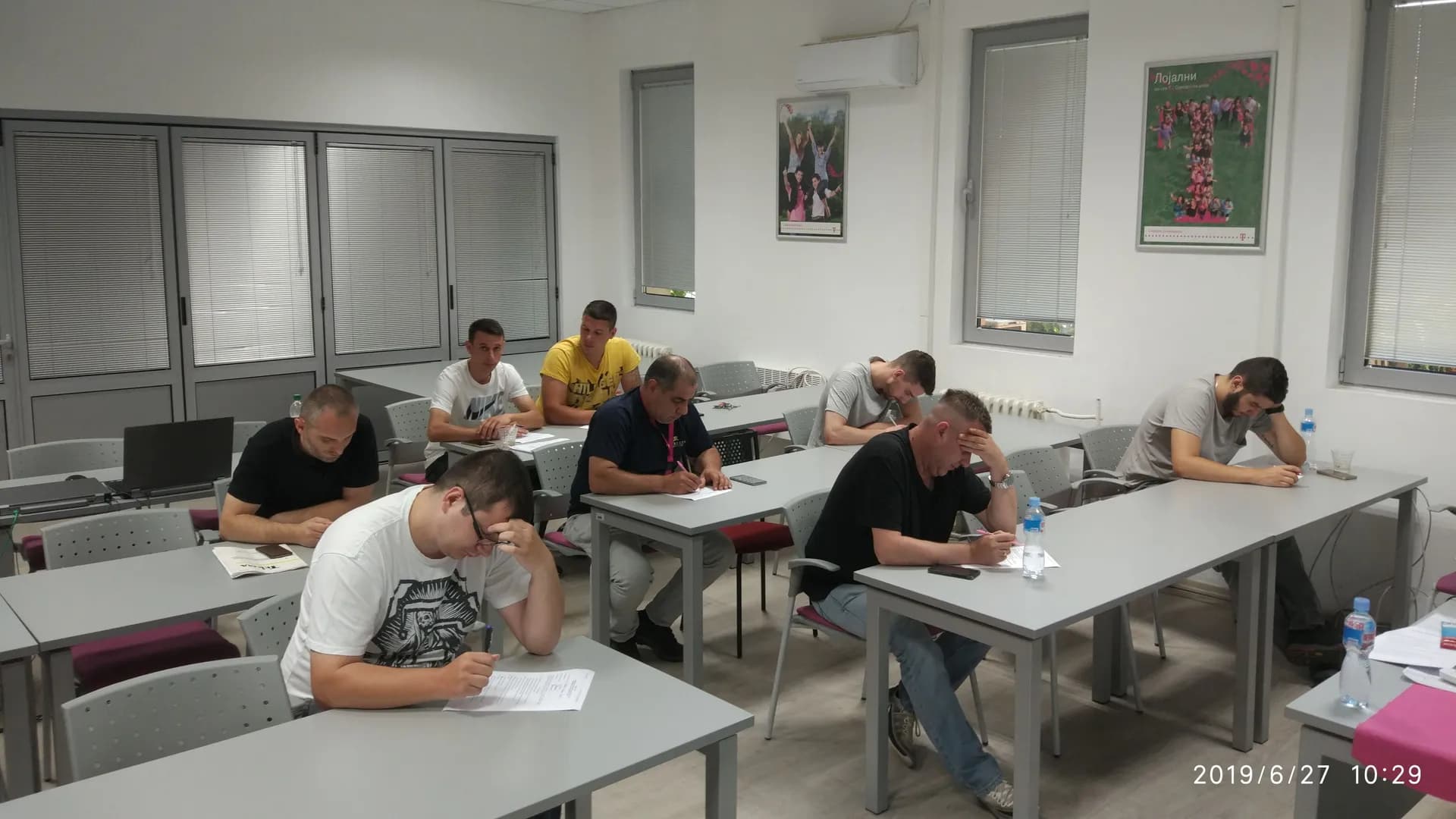
The professional examination is sat to verify the required specialist knowledge. It may be taken by a person who (Article 17-а):
- is a citizen of the Republic of North Macedonia and resides there;
- holds higher education in occupational protection, engineering or another field matching the employer's activity — four-year higher education or 300 ECTS credits;
- has no legally binding ban on practising a profession, activity or duty while the effects of the ban last;
- has at least five years' work experience after graduation in the relevant field.
| Element of the examination | What the law prescribes | Article |
|---|---|---|
| Structure | First part — theoretical (electronic test); second part — a practical case | 17-б |
| Scope of the first part | At least 50 questions with five options | 17-л |
| Interval between the parts | The second part is sat at least 15 days after passing the first | 17-к |
| Duration | 120 minutes for each part | 17-о, 17-п |
| Pass threshold | At least 70% of the available marks, for each part | 17-о, 17-п |
| Sittings | The examination is held at least twice a year | 17-ѓ |
| Certificate | Issued within 15 days of the examination ending | 17-р |
Examination costs are borne by the candidate unless paid by their employing institution; if payment does not arrive at least 15 days before the examination, the candidate is not admitted (Article 17-ќ).
What is new in 2025 and 2026
| Regulation | Source | What it changes |
|---|---|---|
| Act amending the Occupational Safety and Health Act | Official Gazette of RNM no. 74/25 | Competence passes from the Ministry of Labour and Social Policy to the Ministry of Economy and Labour — for licences, the examination, the register and secondary legislation |
| Programme for the occupational safety professional examination | no. 184/25 | New, broader syllabus of 34 topics and an updated list of regulations and literature; replaces the Programme from 206/15 |
| Rulebook on the Register of issued certificates | no. 238/25 | New form; the register is kept in both paper and electronic form; entry within eight days of the certificate being issued or withdrawn |
| Rulebook on the professional examination certificate | no. 239/25 | New certificate form, A4 on white paper; replaces the rulebook from 18/21 |
| Rulebook on scoring continuing-education training | no. 238/25 | Sets how many points active and passive participation carry and prescribes the confirmation form |
| Rulebook on staffing, organisational, technical and other conditions for performing specialist OSH activities | no. 12-3112/1 of 13.5.2026 | New conditions for licensed firms (Article 46); repeals the previous rulebook no. 12-2422/1 of 5.5.2025 |
| Rulebook repealing the rulebook on conditions for performing specialist activities | Official Gazette of RNM no. 167/26 | Repeals the last remnant of the old regime — the rulebook from Official Gazette of RM no. 37/08 |
The two 2026 documents go together. With the rulebook of 13 May 2026 the Ministry of Economy and Labour reorganised the conditions under Article 46, and with the rulebook in no. 167/26 it repealed the 2008 rulebook that had until then remained on the statute book. The result is a single set of applicable conditions — and it is written for legal entities only.
The conditions are specific. The firm must employ at least three certified professionals who have passed the professional examination, from the technical sciences and with at least five years' work experience in occupational safety; at least one full-time, the others part-time but not less than 20 hours a week (Article 3). For measuring biological hazards the persons come from the biological, chemical, biochemical or medical sciences. With three such persons the firm may perform all categories of specialist activity, with no separate headcount per category (Article 11).
Besides staffing, the requirements include measuring equipment with a valid calibration certificate from an accredited laboratory, and premises: 20 m² for administrative and technical work, 15 m² for laboratory testing and 25 m² for instruction (Articles 12 and 14).
A practical consequence: certificates issued after the end of 2025 are on a new form, and the register at the State Labour Inspectorate is kept electronically as well and published on the Ministry's and the Inspectorate's websites (Article 17-у). Before signing a contract, ask for the individual's certificate and the firm's licence.
Continuing development — an obligation that gets forgotten
The safety professional must accumulate 100 points over a five-year period through participation in continuing-education training (Article 18-в). Under the rulebook in Official Gazette of RNM no. 238/25, active participation as a presenter carries 20 points for one topic, and passive participation as an attendee 10 points for one day of training, at home or abroad. The organiser issues a confirmation of the points earned on a prescribed form.
In addition, the safety professional must notify the State Labour Inspectorate by 31 March of the current year of the total points earned in the preceding year (Article 18-г(2)). This is the individual's obligation, but in practice it is the company that should have it in the calendar — and pay for the time and cost of the training, since the employer must enable training and professional development (Article 18(4)).
Comparison: in-house employee versus an external authorised firm
| Criterion | In-house employee | External authorised firm |
|---|---|---|
| Cost | Salary and contributions year-round, plus the examination, training for 100 points and literature — a fixed cost regardless of workload | A contractual fee proportionate to the workload; the law prescribes only minimum amounts for individual specialist activities (Official Gazette of RNM no. 275/19) |
| Availability | Present on site daily, knows the process and the people, responds immediately to an incident | Present by arrangement and on call; in an emergency it depends on the agreed availability |
| Breadth of expertise | One person with one certificate; for measurements, equipment testing and specialised training an external firm is engaged anyway | A team with different profiles and instruments; covers assessment, measurements, training and testing under one contract |
| Legal limitations | May not independently prepare the risk assessment, measurements, equipment testing and training programmes unless the employer meets the conditions of Article 46 — and since May 2026 those require three certified professionals, equipment and premises | Holds a licence from the Ministry of Economy and Labour for risk assessment, equipment testing, the safety statement concept, training programmes and periodic measurements (Article 45(1)) |
| Liability | Reports directly to the employer (Article 18(3)); offence liability remains with the employer and the responsible person | Authorised persons are liable for performing the contracted obligations (Article 6(3)), but the employer is not released from its own liability (Article 6(4)) |
| Continuity | Risk of a gap during absence, sick leave or departure — the obligation goes uncovered | Continuity assured by a team; one person's absence does not interrupt the service |
| Objectivity | An internal employee finds it hard to push back against management | An external finding is more formal and easier to defend before an inspection |
When each option makes sense
An in-house safety professional pays off at larger manufacturing and construction companies, with multiple shifts, multiple locations or continuous technological risk, where someone must be present every day.
An external authorised firm is the logical choice for micro, small and medium employers and for administrative and service activities, where the obligations come down to periodic documents, training and inspections.
A combined model is the most common: an in-house appointed person for day-to-day supervision and records, and a contract with an authorised organisation for the work that requires a licence and instruments.
Penalties
| Offence | Micro and small | Medium | Large |
|---|---|---|---|
| Failed to appoint one or more persons responsible for occupational safety (Article 17, indent 1) | €300 – 400 | €600 – 800 | €800 – 1,000 |
| Failed to engage an authorised health institution for occupational health tasks (Article 17, indent 2) | €300 – 400 | €600 – 800 | €800 – 1,000 |
Amounts are in denar equivalent. The responsible person within the legal entity is fined EUR 200 at a micro and small employer, EUR 350 at a medium one and EUR 450 at a large one, and an employer that is a natural person EUR 250 (Article 57). If the fine is paid within eight days of the payment order, half is payable (Article 54(2)).
How we can help
RI-Opusproekt is an authorised organisation for specialist occupational safety activities. We can take on the entire OSH professional function, or work alongside your appointed person — with risk assessment, training and workplace environment measurements. Send us your activity and headcount via Request a quote.
This article is informational and does not replace professional advice. Regulations change — last updated: August 2026.
This article is informational and does not replace professional advice.